The Decoy Salsa Defense: A Very Serious Investigation Into the Double-Dip Taboo
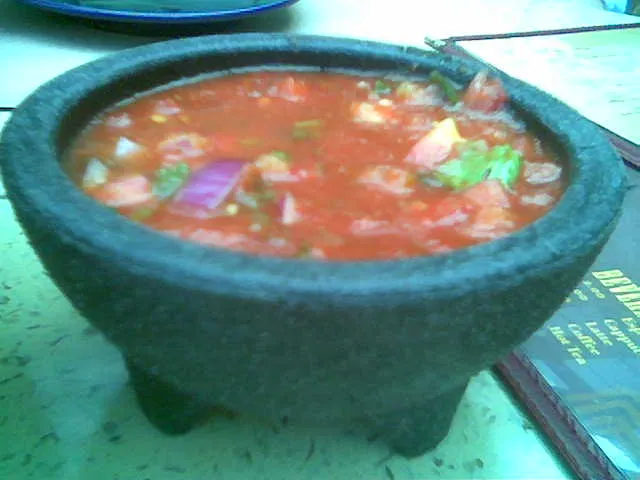
Photo: debaird from So California, CC BY-SA 2.0, via Wikimedia Commons
Every party has a bowl of salsa and a person who ruins it. Sometimes they are the same bowl and the same person, and there is no way to prove it, which is the entire tragedy of the situation.
We are talking, of course, about the double dip: the chip goes in, takes a bite, then returns to the communal bowl for round two. Nobody announces it. Nobody has to. One person at the party sees it happen, and then the rest of the night is divided into two groups — those who know, and those who are happily dipping.
The Alleged Crime
The case against the double dip is straightforward and, on its face, pretty strong. A communal bowl is a shared resource, and a chip that has already touched a human mouth is no longer clean. What goes back into the salsa is not just chip. It is chip plus everything that was on the chip.
The case gets harder to make when you consider what is actually in most party salsas. Acid, salt, onion, garlic, lime. Salsa is not exactly a petri dish of indulgence. It is closer to a hostile environment. This is the argument every double dipper makes, usually while hovering over the bowl mid-sentence, chip already in motion.
And that is the thing about the debate: it is never settled in a debate. It is settled in a look. Somebody's cousin from out of state makes eye contact with the host, raises both eyebrows, and the host has to decide whether they are the kind of person who says something or the kind of person who quietly goes to the kitchen.
The Physics of the Flip
There is a middle faction in this war, and they take enormous pride in their technique: the flip.
A double dipper who flips the chip uses the un-bitten end for the second pass. This is presented as a clean solution, and in fairness, it is a genuine attempt at hygiene. It is also a structural gamble, because the bitten end is now the handle, and a salsa-loaded chip held by its bitten end at a party where people are gesturing energetically is not a stable engineering situation.
The flip faction insists they should be exempt from the judgment. The anti-dip faction points out that the flip requires you to hold the chip with your fingers, which means your fingers were just in the bowl, which means the bowl was always compromised and civilization was always a lie.
Meanwhile, the scoopers — the ones who treat each chip like a tiny shovel and stack a quart of salsa on it — watch this entire argument from a safe distance, because they never have to dip twice.
The Host's Secret Arsenal
The real hero of this story is the host who has quietly solved the problem without accusing anyone.
Their methods are well established at this point. The first is the decoy: a second, smaller bowl placed closer to the known offender, filled from the same jar and refreshed more often. It looks like generosity. It is actually a containment strategy.
The second is the ramekin movement. Personal salsa cups, once reserved for weddings and catered events, have quietly gone mainstream at house parties. No sharing, no accusation, no eye contact across the living room.
The third is the salsa spoon, which is theoretically perfect and practically ignored. A spoon is only a solution if people are willing to be the person who uses a spoon at a party, and most people are not.
And the fourth, the nuclear option, is a double-bowl setup where the chips live in one vessel and the dip in another, forcing a plate-and-dip workflow rather than a hover-and-dunk workflow. This works. It is also the least fun option available, which is why it never lasts more than one party.
The Cultural Defense
The double dippers have an argument worth hearing, even if it makes the other side hold their breath.
Their position is that thickness matters. Thin, watery salsa? Agreed, keep the chip out of the bowl on the second pass. But thick queso, a proper seven-layer dip, spinach-artichoke, buffalo chicken dip at a Super Bowl party — these are load-bearing dips. A single pass does not deliver enough. A second pass is not greed. It is structural necessity.
The efficiency argument is even simpler: a bowl of salsa is going to be consumed in about eleven minutes regardless. If the double dip were truly catastrophic, nobody at these parties would ever survive the night. And yet here we all are.
The Reader Verdict
The Squabbles comment section has, over time, split into three very loud camps.
The Crime Camp says a shared bowl is a shared trust and that the double dip is a small, low-stakes act of contempt for the people around you. They do not accept the flip as a defense. They would like the spoon, please, and they are not going to keep bringing it up but they will absolutely keep bringing it up.
The Love Language Camp says the double dip is not a hygiene failure, it is closeness. You do not grab a bowl with someone until you have survived a few things together, and a family gathering is exactly the place where that should not matter.
The Efficiency Camp says there are roughly forty minutes of a party worth enjoying and the salsa is going to be gone in eleven, so we can all relax and let the chip complete its mission.
Nobody has won. Nobody will win. That is what makes it a classic.
Where This Leaves Us
There is no ruling, and any article that pretends otherwise is lying to you. What there is, is a set of small courtesies that keep the party alive: offer the spoon, provide a second bowl, and if you are the double dipper, take the second pass when the host is not making eye contact from the kitchen doorway.
And if you suspect your role in this debate, do not say it out loud. Just watch your host's hand hovering near the cabinet where the extra ramekins live. They know. They always know.