Beep, Bag, and Accuse: The Self-Checkout Aisle Is America's New Trust Fall
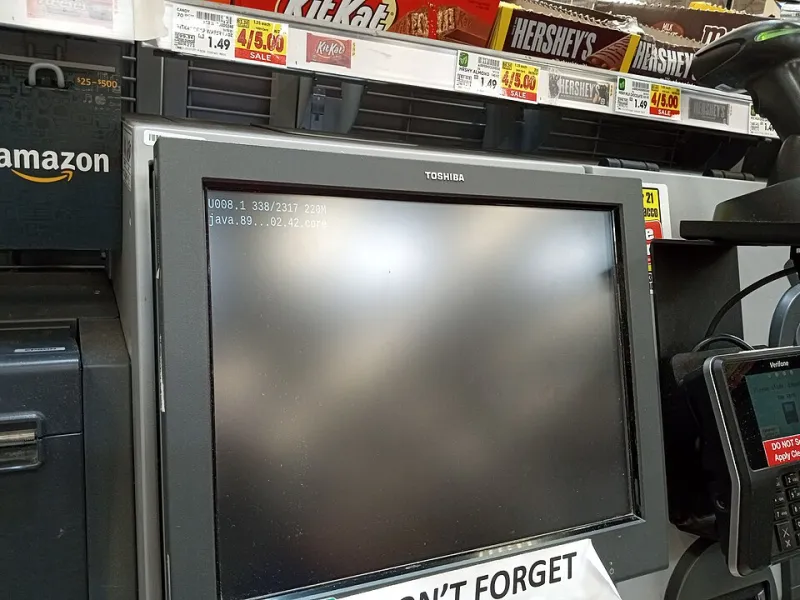
Photo: Gayest Frogs, CC BY-SA 4.0, via Wikimedia Commons
The machine speaks in a tone that suggests it has already made up its mind about you. Please place the item in the bagging area. Please wait for assistance. Please do not remove the item from the bagging area. Every self-checkout lane in America is running the same experiment, and the question it's testing is not whether you can scan a barcode. It's whether you can be trusted with a banana.
What was pitched as a convenience has quietly become one of the most revealing public spaces in the country. Twelve square feet of metal and guilt, staffed by a camera, a scale, and a recorded voice with the emotional range of a smoke detector.
The Lane Where Everyone Is a Suspect
Self-checkout began life as a speed play. Fewer cashiers, shorter lines, more control over how your groceries get bagged. Somewhere along the way it turned into a referendum — on labor, on theft, on whether the person ahead of you with eleven items in the ten-item lane is a free spirit or a menace.
The machines themselves are built on suspicion. Weight sensors, cameras, loyalty prompts, and a scale that treats a moved cantaloupe like a border violation. You are not checking yourself out. You are being checked out.
The Cashier Loyalists
They exist, they're growing, and they have a case. The loyalist will tell you that a human being scans faster, bags better, and knows that the cilantro needs its own bag because it's going to wilt against the milk. They'll also tell you what the self-scan aisle never will: this is a job, and it's somebody's.
There's a quiet economy in the loyalist position. Small talk, a bagger who remembers your name, the small dignity of a transaction between two people. Some of it is nostalgia. Some of it is a person watching a neighborhood job evaporate and deciding, on their own twenty items, to push back.
The Self-Scan Evangelists
On the other side stands the evangelist, who has optimized their life and would like you to know it. They have the app. They have the produce codes memorized — 4011 for bananas, forever. They scan with the tempo of a jazz drummer and are visibly pained by anyone ahead of them who treats the screen like a riddle.
Their core argument is autonomy. No line, no small talk, no bagging decisions made on their behalf. The machine is rude to everyone equally, which they consider fair.
The Receipt-Check Refuseniks
The most interesting faction operates at the exit. A greeter asks to see the receipt, and a decision gets made in half a second: hand it over, or wave and keep walking.
Refuseniks argue they already scanned, already paid, already watched a camera count their items. To them, the second check is a free citizen being quizzed by a retail employee. Hand-overs argue it's ten seconds, it's not the greeter's policy, and making a point at the door of a Target on a Sunday is a strange way to spend one's one precious life. Both sides are correct, which is why the argument has legs.
The Great Banana-Potato Gray Market
Then there's the gray zone. The organic apples rung up as conventional. The bakery roll sold by the each and logged under a different bread's code. The banana — the most philosophically loaded fruit in retail — scanned as a potato, a transaction that is technically theft and functionally a rounding error.
People who would never pocket a steak will happily take the cheaper code for a bag of cherries and feel nothing. The moral line most shoppers draw isn't between legal and illegal. It's between clever and greedy. Ask any retail analyst and they'll tell you shrink is real money. Ask the shopper and they'll tell you the machine got the weight wrong and they simply stopped caring.
The Shrink Math Nobody Agrees On
Retailers say self-checkout bleeds. Some chains have pulled the lanes back, added item limits, or stationed more staff to babysit the screens. Shoppers respond that the same stores cut hours, cut cashiers, and then acted surprised when the line got weird.
The two arguments don't actually touch each other. One side is arguing about loss. The other is arguing about time and dignity. Both keep losing.
Where the Lanes Go From Here
Smart carts, scan-and-go apps, and camera-based checkout are all coming for the beeping podium. Eventually the scale will stop asking you to wait for assistance, and the receipt check will happen invisibly, and nobody will get to feel wronged at a doorway ever again.
Until then, we're left in the twelve square feet with the recorded voice, deciding what kind of person we are when a machine assumes the worst. The machine isn't going to change. But every time you scan the correct code for the cherries, you're casting a vote — and the vote is for a world where being trusted is normal, not a surprise. Whether that's worth eight extra cents is exactly the kind of thing this place exists to argue about.