The Leash Is Not a Suggestion: A Field Guide to the 'Can I Pet Your Dog' Standoff
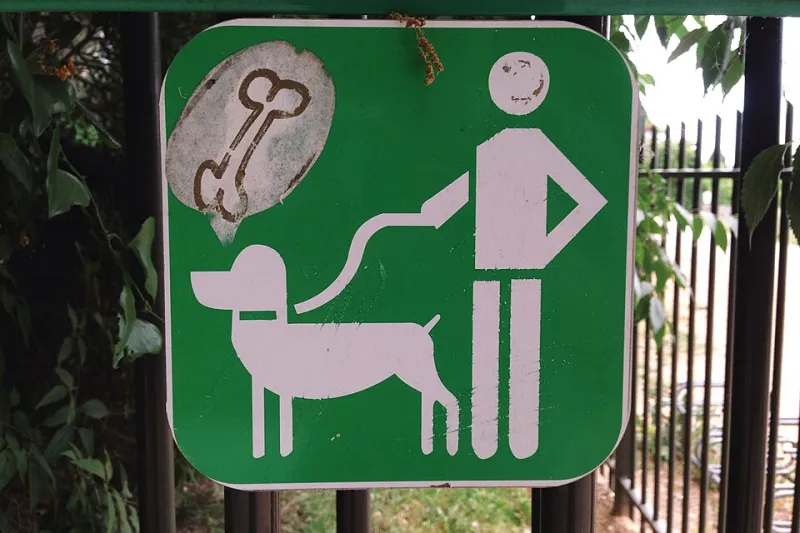
Photo: Alexander Baranov from Montpellier, France, CC BY 2.0, via Wikimedia Commons
The dog is sitting outside a coffee shop in a harness, doing absolutely nothing. Within ninety seconds a stranger is descending, hand outstretched, cooing. The owner's face does a very specific thing — half smile, half flinch — and the question everyone should have asked arrives late, if at all.
"Can I pet your dog?" Five words. That's the entire ask. Yet somehow, in parks and patios and hardware stores across the country, that sentence is treated as optional.
The reaching hand is a consent test nobody agreed to
Here's what every dog owner learns fast: a leash is not a force field. Strangers read it as an invitation with a handle attached.
And the request to pet someone's dog is often the first real boundary negotiation a lot of adults have had all week. Which explains the weirdness. Some people ask. Some people announce and reach simultaneously, treating the question as a formality already settled by their outstretched arm. Some skip the approach entirely and go straight for the top of the head, fingers descending at speed like a claw machine.
Why owners flinch
Because the stakes are invisible to everyone but them.
A dog can be friendly, well-trained, and still have a bad hip, a sore ear, a history with hats, or a hot spot that makes touch feel like sandpaper. A rescue can be six months into a whole new life and still flinch at a fast hand. A five-pound dog riding in a tote bag can get dropped when it squirms.
Owners also carry the liability. If your dog reacts — a growl, a warning snap, even a hard stare — the story writes itself right there in the parking lot: aggressive dog, careless owner. Nobody files a report about the stranger who approached a leashed animal without asking.
Service animals are not the same conversation
A working dog in a vest is on the clock. Distracting it isn't a minor faux pas — it can mean the difference between a handler hearing a fire alarm and not, or getting warning of a medical event before it happens.
The etiquette is blunt: don't touch, don't talk to it, don't make kissy noises, don't let your kid crawl over to say hello. There are only two questions you're generally allowed to ask a handler — whether the dog is a service animal, and what task it performs. Anything past that is a stranger auditing someone's medical reality in the cereal aisle. And a vest bought online doesn't make a service animal, but that's a matter for the law, not for you in the middle of Target.
Kids, leashes, and the handoff
Children are the best argument for ask-first and the worst at following it. Toddlers move at chest height with grabby hands and zero fear, and a dog's face is right there at eye level.
The line that works: "Ask the grown-up, not the dog." Teach kids to stop three steps away, ask the owner, and then let the owner run the interaction. If the answer is yes, the kid holds out a flat hand and lets the dog come to them. If the answer is no, the kid says "okay, thank you" and keeps walking.
A no isn't an insult. It's a schedule, a temperament, a vet appointment, or simply a dog who's already absorbed four pats today and is done performing.
Friendly is not the same as reckless
A wagging tail does not mean yes. Tail wagging is arousal, not joy — a stiff, high, fast wag can be a warning shot.
Read the dog before you ask. Ears pinned back, body frozen, lip licking, yawning, backing away, or the dog physically positioning itself behind the owner's legs — all of that is a no, regardless of what the human says. A dog who is eating, chewing a bone, or tangled in a retractable lead in a crowd is not a meet-and-greet candidate.
And if a dog is tied up outside a shop alone? Don't. That's an animal with no one to advocate for it and a lot of feelings about where its person went.
Scripts for both sides of the leash
For the asker:
- "Is he friendly? Is it okay if I say hi?"
- "Not asking to pet — just wanted to say he's beautiful."
- "Can my kid say hello, or would you rather we didn't?"
For the owner:
- "Not today, thanks — he's in training."
- "He's friendly but nervous. You can let him sniff your hand if you want."
- "I'd rather you didn't, but thank you for asking."
The strongest move for owners is the pre-emptive ask. A warm "Sorry, he's not up for pets today" as someone approaches does more work than a defensive "he bites" ever will. It's clear, it's friendly, and it doesn't require a lecture.
When someone reaches anyway
Physically block. Step between the person and the dog, turn your shoulder, and keep walking. You do not owe a full explanation and you definitely don't owe a debate in the middle of a farmers market.
If someone touches your dog without permission, "Please don't touch him" is a complete sentence. It is not rude. Whatever their face does afterward is their business.
The five words are the whole point
Here's the strange truth: most dog people love talking about their dogs. Ask, and you'll often get a story, a breed lecture, and a new park friend for life.
Skip the ask, and you get a tense owner, a startled animal, and a small public scene that ruins everyone's afternoon.
Five words. Free to say. Expensive to skip.
Got a hot take on off-leash trails or the neighbor whose doodle barrels up to everyone in sight? You know where to take it.